News and lifestyle magazine for Gstaad, Switzerland
Vancouver-based freelance writer, professional editor, great listener

This article was originally published in The Bastion, currently under renovation.
Christian Kluxen knows he can be intimidating. Now in his seventh season as Victoria Symphony’s Music Director and Principal Conductor, he often meets Victorians who, upon being introduced to an actual maestro, respond with a measure of discomfort: “When I say what it is I do, they’ll say, ‘Oh, that’s…interesting.’ I get from them a feeling of solemn fear, like they’re curiously fearful about the classical concert form, unsure how to approach it.”
He understands why. “It’s how I would feel if I was asked to go to Copenhell”—a massive heavy metal festival held each year in Kluxen’s native Copenhagen—“I wouldn’t even know what to wear. I don’t usually headbang—would I have to do that?”
Kluxen feels an artistic responsibility to broaden Victoria Symphony’s style and scope, beyond what established subscribers expect: “I want to give them the music they don’t know they like.” Transforming apprehensive locals into regular concertgoers is one of the many challenges Kluxen and symphony CEO Matthew White face in their efforts to ensure that Victoria maintains a world-class symphony orchestra. Programming is a crucial needle to thread, balancing tradition against innovation.
The symphony’s job, according to Kluxen, is to “make people want to be in a closed room with their emotions for one more minute than they feel comfortable with.” It’s this emotional resonance of the form that he feels is key to attracting new fans. He’s well aware of the imposing nature of classical music, that it feels to some like an intellectual exercise rather than a night of simple entertainment.

This article was originally published in The Bastion, currently under renovation.
Before his introduction to BC developer Reliance Properties, Logan Ford had no reason to trust landlords. He arrived in Victoria from Calgary in 2007 as an HVAC tradesman by vocation and an oil/acrylic painter by avocation, just in time for the 2008 recession to dry up most of the available construction work. “I ended up framing houses for twelve bucks an hour,” says Ford. “I was miserable, hating my boss, and one day I just quit. I didn’t know what to do, but I was always making art.”
The week he left his job he sold a painting for $500, “which paid my rent, so I thought, okay, well, I’ll just keep this going as long as I can.” Victoria has long been a city rich in visual artists and poor in spaces for making and exhibiting art.
To navigate this paucity of affordable Victoria studio space, Ford—together with partner Ian George—rented 600 square feet in an old building in Burnside Gorge, and in 2013 the Rockslide Studio & Gallery was born. Within three years they had expanded to 4000 square feet, providing affordable studio space to a community of twenty-five artists. At the end of their initial five-year lease, the landlord doubled the rent in a successful effort at evicting Rockslide from the property.
Ford and George were offered a deal on a rundown property on Herald Street, on the condition they would restore the building at their own expense. They accepted on the assurance of an eight-year residency, and after months of major surgery—including hazardous-material removal, a new roof, and a fully muralled exterior—the landlord promptly sold the building to a Vancouver developer, who immediately demolished it. Rockslide was homeless once again.
They moved into a small industrial building in Rock Bay next, but their community was growing and they were in need of more space, not less. Ford’s persistence led to a meeting with Reliance, who had purchased the four-storey art deco heritage building on Blanshard at Burdett in 2019 with an eye toward turning it into a hotel topped by an eighteen-storey condo tower. Ford brokered what he terms “a great deal” for Rockslide to move in with a short-term lease, and took over the first and second floors.
“Within a few months the word got out that we had affordable studio space, and there was so much demand right away that we took the rest of the building, and now we have a huge wait list,” says Ford. With a temporary lease until January 2024, the building, once the home of the BC Power Commission (a precursor of BC Hydro), boasts sun-filled studios for eighty-five artists, four galleries, and five unique arts and culture organizations in addition to Rockslide: the Ministry of Casual Living, Supply Victoria, the Victoria Tool Library, Haus of Owl, and Sweetpea Gallery. Built as a WWII-era hospital that was rendered unnecessary by the end of the war, the generously wide hallways (for stretcher access) and high ceilings provide for excellent gallery displays. It’s a dream space for working artists, albeit a potentially temporary one.

This article was originally published in The Bastion, currently under renovation.
Victoria is an attractive city, in more ways than one: she’s a looker, of course. But on a deeper level, she entices people who value authenticity, creativity, and nature. Perhaps no local business better serves these appetites than Silk Road Tea.
Its company values of “premium quality ingredients, exceptional customer service, an eco-friendly approach, and a commitment to community” have proven a successful recipe, one that has kept aromatic, uplifting decoctions flowing from the edge of Chinatown for an astonishing thirty years.
These values were codified by founder Daniela Cubelic, nationally celebrated as both a certified tea master and an entrepreneur. She shares her passion and knowledge with an erudite cheerfulness, as lively and endearing as a steaming cup of Darjeeling. Considering her company’s three decades of accolades and growth, it’s striking how little she takes for granted.
“Climate change has been hitting tea-growing countries for longer than most have been aware of in North America.” Not to mention the tightrope navigation of the pandemic and the supply-chain calamity courtesy of the relentless war in Ukraine. “It’s a victory that we’re still here.”
When the lockdowns first dropped, Cubelic assumed she would be busy coming up with new teas “to help people escape.” But the reality was surprising: “What became apparent early on is that what people actually craved was comfort.” Which meant consistency, familiarity. “I had better not run out of elderflower, because if we don’t have Angelwater [an herbal decoction of elderflower, spearmint, lavender, and rose], people will lose their minds.”
There is a population divide between those of us who relax into the comfort of reliable sameness (mass-market beer, double doubles, et al.) and those who seek inconsistency, chasing novelty with curious palates and restless cravings. Silk Road has long been a destination for adventurous tea lovers. But even the intrepid consumer, overwhelmed by the uncertainty of our current climate, may find themselves a creature of habit, seeking a steadying anchor against today’s many storms. For any business committed to a purely organic product, uniformity of flavour is becoming exponentially harder to achieve.
In Silk Road’s early days, only an occasional climate anomaly would affect tea crops. “We’ve had hard-weather years before, and seen lowered harvests, or ingredients not tasting as good, but then it would normalize.” About fifteen years ago, however, Cubelic began to see stark shifts in flavour profiles, with producers talking to her about how rainfall patterns were starting to profoundly affect the plants. Harvest season got shorter, interspersed with freak hailstorms and heatwaves. Tea started to change.

This article was originally published in The Bastion, currently under renovation.
The theorbo, at first sight, is an impossible instrument. It looks like a kind of otherworldly sitar—large-bodied with an extraordinarily long neck and 14 strings—playable only by a ten-foot space creature with tentacles for hands. Introduced in 1580 to be the “perfect accompaniment for voice,” it still holds the title as the largest member of the lute family, and provides the high, sprightly notes typically associated with strummed instruments, while also contributing the deep basso continuo sections usually provided by a double bass or organ.
While the theorbo’s unwieldy size lends itself easily to the spotlight, it’s far from the only curious, bygone instrument to appear at any given show produced by the Early Music Society of the Islands (EMSI): be prepared for crumhorns, shawms, cornetts, vielles, sackbuts, and hurdy-gurdies.
At EMSI’s next performance, Concert of the Birds (April 22, 2023, St. Andrew’s Presbyterian Church), one can witness the theorbo being mastered first-hand—by a typically sized human, no less—and hear the powerful intonations of these largely forgotten, but once incredibly popular, instruments.
The program will be performed by La Rêveuse, a leading early-music ensemble from Orléans, France, featuring a selection of baroque works inspired by nature’s chirpy choir, the birdsong. This subject has informed their choice of instrumentation: theorbo, flutes, viola da gamba (a six-stringed predecessor of the cello), and a recorder and flageolet (both members of the fipple flute family). It’s a rare opportunity to experience the sounds of these far-out instruments in the hands of some of the world’s leading musical authorities.
Even to a fan of classical music, some of these contraptions may seem alien. Contemporary orchestras use essentially the same collection of tools, changing the number of pieces from each family—strings, woodwinds, brass, and percussion—according to the work at hand. But limiting an orchestra’s arsenal in this way is a relatively new restriction. As EMSI artistic and executive director Bill Jamieson says, “There was a huge amount of instrumental experimentation up until the nineteenth century, but then things kind of got petrified.”
This article was originally published in The Bastion, currently under renovation.
The commanding stone structure on the southeast corner of Pandora and Quadra is not what it seems. At first it appears to be another member of Victoria’s congregation of grandiose heritage churches, each vying to outdo the others in scale and piety.
The building itself appears heavy, both in mass and solemnity. It’s a serious place for serious people performing serious tasks. It was commissioned in 1889 by the growing Victoria Methodist community—a non-conformist offshoot of the Church of England named for their “methodical pursuit of biblical holiness”—who had outgrown their original church building (where the CTV studios are now housed at Pandora and Broad). The original church had developed an impressive music program, complete with a full orchestra, and part of architect Thomas Hooper’s brief was to design the new building with splendid acoustics.
In 1925, the Methodists merged with the Presbyterian Church to form the United Church of Canada. As the Presbyterians already had a grand church building of their own, they found themselves with a redundant house of worship. In 1996, the United Church put one of them up for sale, leaving the choice of which building to surrender up to the buyer.
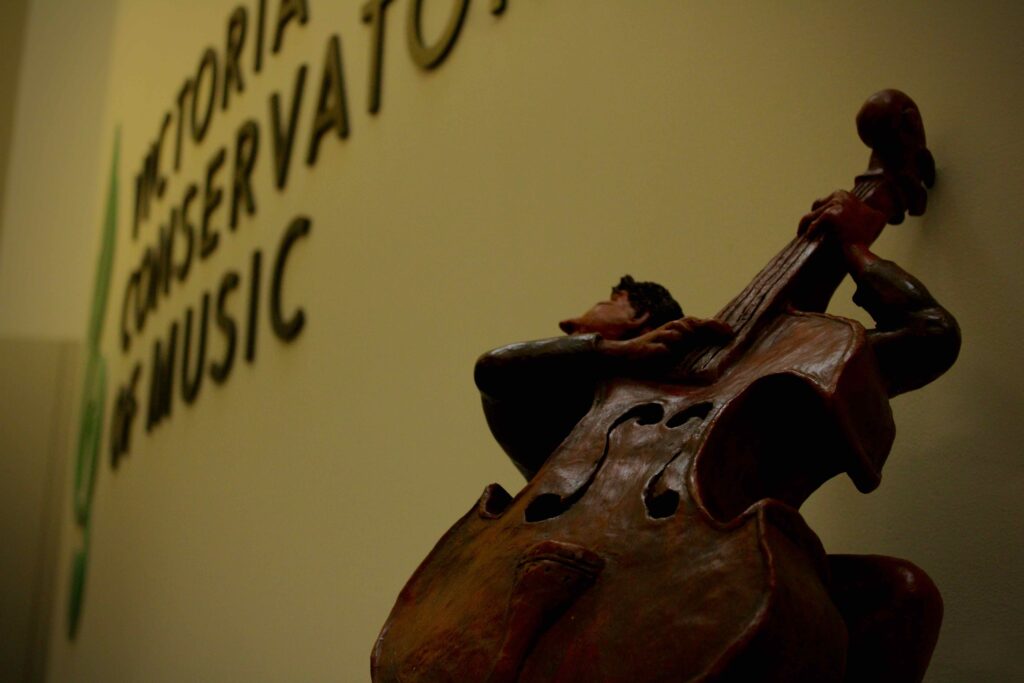
The Victoria Conservatory of Music happened to be looking for its forever home at the time, after tenancies in Craigdarroch Castle and St. Ann’s Academy. A building designed to exemplify music made the choice between churches an easy one, and the magnificent Casavant Frères pipe organ that backdrops the stage of the old sanctuary, now the Goolden Hall, must have made the location seem like a godsend.
The conservatory bought the property in 1997 for $2 million, the current price of a 60-year-old single-family home in Oak Bay, and retrofitted it with classrooms and offices. Today VCM comprises five unique schools. The classical programs now operate alongside the School of Contemporary Music. The Department of Postsecondary Studies prepares musicians for the business side of their career. Early Childhood Music offers a foundation in music for kids under one year old to age five, and the digitally focused School of Music Technology and Creativity approaches music-making forensically.

This article was originally published in The Bastion, currently under renovation.
The theatre arts are a tough sell to contemporary audiences. For Victoria’s long-serving stage companies, the past two years have jeopardized revenue from even their most loyal supporters. But live performances are finally back. As are audiences, both bare-faced and masked. The industry can now return its attention to the eternal challenge: getting butts in seats.
What does the term theatre evoke for you? Corseted, fainty women being menaced by puffy-sleeved actors—nay, thespians—with rapiers and densely olde language? Unless you were among those daydreamy few seeking asylum from the militancy of high school by puckishly hopping around drama class, you likely share this perception.
And this is why our local theatre industry is working against two critical marketing obstacles: the long tail of its antiquarian image, and its audiences’ past experiences with hammy plays (à la Waiting for Guffman).
What unites us, the zealots who seek out that exalted communion between audience and performer, is that we were all lucky enough to experience one show, or one moment within a show, that articulated a private conviction so perfectly that it made us feel less alone.
It’s a sharply visceral connection, a naked mirror, and it’s why the form has remained essentially unchanged for so long. For a company to get that good, to be able to siphon that power, it must work at its craft for ages, with unflagging love and repetition.

You’ve done it. You’ve committed to the writing life. How are you feeling? Excited? Scared? Bored? Lonely? Us too. Welcome to the band—we’re delighted that you’ve decided to join us. We’re a bizarro group and legion, all of us utterly, fantastically, bewilderingly unique, except for one little idiosyncrasy: we all have stories screaming and punching and kicking inside of us that we need to wrestle into the world. There are many out there with the same constipation as us, but they may let it loose through interpretive dance or song or watercolours, or by yelling it into the faces of people in line for the bus. But not us. Not we. We’re the scribes, the men and women of letters. We adore specificity and nuance. We love the tranquility of words nestled on a page, the calm, rational, and quiet way they present themselves to our audience. Our hearts beat for that alchemic conversion of action and imagery and diaphanous emotion into the solidity of language. We’re the Hobbits of the storytelling tribe, and we don’t give a fig if you haven’t yet been paid for your writing. If you’ve managed to set a word down on a page and followed it, tentatively or resolutely with another, you’re one of us and you are welcome here. Make yourself comfortable and we’ll put the kettle on.

It’s a tough proposition, being asked to dispense advice on making better bartenders in an age when everyone and their cat has an opinion on what elevates a cocktail to a great cocktail. The world surely needs excellent bartenders, perhaps now more than ever, as those in charge of weaponized countries whisk us all toward hell in a handcart, but the essential problem is this: hyperbole aside, bartending actually is an art when practiced at a level worthy of charging upwards of fourteen bucks a pop for a few ounces of boozes mixed in a glass. And like all artists, the bartender will chisel out their unique style and form over time and with practice, through love and repetition, and they will adopt and discard many influences as they make their way through their career. We’re supposed to be unique, it’s how we build a wonderful and loyal clientele, and the last thing we need is a nation of clone bartenders. Bringing the wonder of you, your precious singularity, into the world over your bar top is a generosity worth paying for. But like the other artists—our musicians, actors, painters, hockey players—there are certain fundamentals we must all master if we aspire to greatness. When it comes to our careers we have but two choices: to be either great or not great. That’s it. So if you’re the type that would like to be great at that thing you do, we must discuss fundamentals. And my number one, all-time, best-of-the-best, fundamental advice to the trade is this: Tend your bar from the outside looking in.

The 2016 competition season is in full swing. I can just about feel the breeze from hundreds of tummy butterflies as bartenders from here to … well, everywhere, get their game faces on. Hopefully you’ve got a good and trustworthy coach to guide you through the challenges to come, but they’re not easy to find. Ask a dozen grizzled old bartenders for their best piece of advice on winning bartending competitions and in all likelihood you’ll get twelve different bright ideas: develop a strong thesis, balance your acid with your sugar, don’t forget to laser beam your wash line, bring your own ice, no spilling, double shake, reverse dry shake, speak up doublestir CLEANUPYOURMESSSTANDUPSTRAIGHTCOMBYOURHAIR!
 Simon Ogden